Sourdough starter feeding calculator
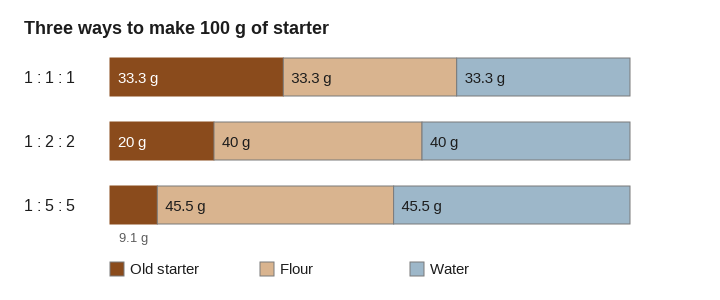
Tell it how much starter you need and which ratio you feed at. It gives the grams of old starter, flour and water to mix, so you aren't left with a big jar of discard.
Change your starter's hydration
A stiff starter (50 to 60%) rises more slowly and tastes a bit more sour. A liquid starter (100% or more) is quicker and milder. Switching is a matter of feeding with a different flour to water ratio for a few days. The numbers above get you there in one feed.
Which ratio to use
The first number is the starter you keep, the other two are the fresh flour and water. More fresh food per gram of starter means the yeast and bacteria take longer to eat through it, so the starter peaks later.
| Ratio | Rough time to peak at 75°F (24°C) | Good for |
|---|---|---|
| 1 : 1 : 1 | 4 to 6 hours | Feeding in the morning and baking the same day |
| 1 : 2 : 2 | 6 to 8 hours | A daytime feed, or a warm kitchen |
| 1 : 5 : 5 | 8 to 12 hours | Feeding at night and mixing dough in the morning |
| 1 : 10 : 10 | 12 hours or more | Very warm kitchens, or a long gap between feed and bake |
These times are a starting point. Every starter is different, and a cooler kitchen can add several hours. Watch your own jar for a week and write down when it peaks.
Questions
What does 1:1:1 mean?
One part starter, one part flour, one part water, by weight. 20 g starter, 20 g flour and 20 g water is 1:1:1. So is 50 g of each.
How much starter should I keep?
Only as much as your next bake needs, plus a little extra. Keeping 20 to 50 g in the jar and building up the night before a bake saves flour. This calculator works backwards from the amount you need.
Why do I have to discard starter?
If you never take any out, the jar doubles in size with each feed. Discarding keeps it small and keeps the ratio of fresh food to old starter high enough for a strong rise. If you only mix the amount this calculator gives, there's little or nothing to discard.
Can I feed with whole wheat or rye flour?
Yes. Whole grain flour usually makes a starter rise faster and smell stronger. It also absorbs more water, so a 100% rye starter looks thicker than a 100% white one.
How do I know when my starter is ready to use?
It has at least doubled, the top is domed or just starting to flatten, and it's full of bubbles. If it has already collapsed and smells sharp, it's past its peak. You can still use it, but the dough will rise more slowly.
Should I measure by weight or by volume?
By weight. A cup of flour and a cup of water weigh very different amounts, so a "1:1:1 by volume" feed is a much wetter starter than 1:1:1 by weight.