Sourdough calculator
Pick how much dough you want and type your percentages. The table fills in the grams. Flour and water that come from your starter are counted, so the hydration you type is the hydration you get.
What's in the dough
Hydration: 75% counting the starter, 72.2% from the bowl water and flour alone.
All the flour in the dough: 508 g, of which 51 g comes from the starter. All the water: 381 g, of which 51 g comes from the starter.
Get the starter ready
Feed your starter about 4 to 12 hours before mixing, depending on the ratio and how warm your kitchen is.
How the numbers work
Bakers write recipes as percentages of the flour weight. Flour is always 100%, and every other ingredient is a share of it. A dough with 1,000 g of flour and 750 g of water is 75% hydration. Salt at 2% is 20 g.
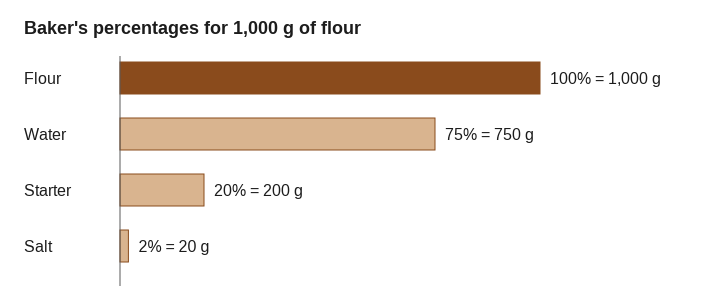
Starter makes this harder, because starter is flour and water too. 100 g of starter at 100% hydration holds 50 g of flour and 50 g of water. If you ignore that, a recipe written as 70% hydration really comes out wetter than 70%. With "Count the flour and water inside the starter" on, the calculator takes that flour and water off what you add to the bowl, so the whole dough lands on the hydration you typed.
To build the recipe, the calculator works out the total flour from the dough weight you want:
Total flour = dough weight ÷ (1 + hydration + salt + add-ins)
Then water, starter and salt are each that flour times their percentage. The flour and water already in the starter come off the amounts for the bowl.
Typical starting points
| Bread | Hydration | Starter | Salt |
|---|---|---|---|
| First loaf, easy to shape | 65 to 70% | 20% | 2% |
| Everyday open-crumb loaf | 72 to 78% | 15 to 20% | 2% |
| Very open, wet dough | 80 to 85% | 15 to 20% | 2 to 2.2% |
| Sandwich loaf in a tin | 65 to 70% | 15 to 20% | 1.8 to 2% |
| Half whole wheat | 78 to 85% | 20% | 2% |
Whole wheat, rye and spelt soak up more water than white bread flour, so blends with a lot of whole grain need a higher hydration to feel the same. If you're new to sourdough, start near 70% and go up a few points at a time.
Questions
How much starter do I use for one loaf?
Most recipes use 15 to 25% starter, measured against the flour. For a 900 g loaf at 75% hydration that's about 100 g of starter. Less starter makes a slower rise, which some bakers use on hot days or for an overnight bulk ferment.
Does the starter count toward hydration?
Yes. A 100% hydration starter is half flour and half water, and both end up in the dough. This calculator counts them by default. Turn the setting off if you're following a recipe that lists its hydration from the bowl ingredients only.
How much salt goes in sourdough?
About 2% of the flour weight. That's 10 g of salt for 500 g of flour. Some bakers go to 2.2% for a saltier crust, and sandwich loaves often use a little less.
Can I use cups instead of grams?
Not reliably. A cup of flour can weigh anywhere from about 120 g to 150 g depending on how it's scooped, which can change hydration by several points. A kitchen scale makes the percentages work. If your scale reads ounces, switch "Show weights in" to ounces.
How do I scale a sourdough recipe?
Type the recipe's percentages into the table, then change the number of loaves or the dough weight. If you only know grams, put them into the hydration calculator first to get the percentages.
I only have 60 g of starter. What can I make?
Set "Work it out from" to "Starter I have ready" and type 60. The calculator sizes the whole recipe around that starter at the percentage you set.
Where do add-ins like seeds or cheese go?
Use "Add seeds, cheese or another add-in". They're weighed as a percentage of the flour and added to the dough weight, but they don't change the hydration. Soak dry seeds first, or they'll pull water out of the dough.