Sourdough hydration calculator
Type the grams from your recipe. You get the hydration with the starter counted, the hydration most recipes print, and what to add if you want a wetter or stiffer dough.
Why the starter changes the number
Hydration is the water weight divided by the flour weight. The catch is that starter is made of flour and water. Take a common recipe: 500 g flour, 350 g water and 100 g of starter at 100% hydration. Many recipes call it 70%, because 350 ÷ 500 = 70%. But the starter brings in 50 g of flour and 50 g of water, so the dough really holds 550 g of flour and 400 g of water. That's 72.7%.
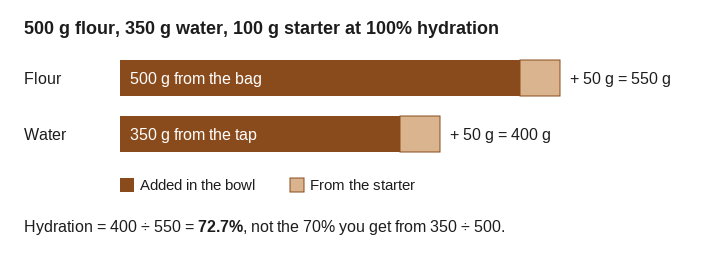
A difference of two or three points is small, and either number is fine if you stay consistent. It matters more when you use a lot of starter, a stiff starter, or when you compare your dough with someone else's recipe written the other way.
What different hydrations feel like
| Hydration | How the dough behaves (white bread flour) |
|---|---|
| 60 to 65% | Firm and smooth. Easy to shape. Tight, even crumb, good for sandwiches and bagels. |
| 68 to 72% | Soft but manageable. A good place for a first sourdough loaf. |
| 73 to 78% | Slack and a bit sticky. Holds its shape after a few sets of stretch and folds. Open crumb. |
| 80 to 85% | Wet and sticky. Needs wet hands, strong flour and practice to shape. |
| Over 85% | Close to a batter. Usually baked in a tin, or as focaccia or ciabatta. |
Whole wheat and rye absorb more water, so the same hydration feels stiffer with them. Flours also vary by brand. If your dough feels much wetter than the table suggests, your flour may be lower in protein. Hold back 5% of the water and add it during mixing if the dough can take it.
Questions
How do I calculate sourdough hydration?
Add the water in the starter to the water you add, and the flour in the starter to the flour you add. Divide the water by the flour and multiply by 100. For a 100% hydration starter, half its weight is flour and half is water.
What is a good hydration for sourdough?
For a first loaf, 68 to 72%. Most open-crumb country loaves sit between 73 and 80%. Higher isn't better on its own. A well-fermented 72% loaf beats an underproofed 85% one.
My dough is too wet. How much flour do I add?
Type your recipe above, then type a lower hydration under "Change the hydration". The calculator tells you how much flour to add, and the salt that goes with it so the salt stays at the same percentage. Add the flour a little at a time while you fold.
Do milk, oil or honey count toward hydration?
Milk is about 87% water, so count 87 g of every 100 g as water. Oil, butter and honey make dough feel softer, but most bakers leave them out of the hydration figure and treat them as extras.
What's the hydration of my starter?
It's the water you feed divided by the flour you feed. Equal weights, such as 50 g flour and 50 g water, make 100%. 50 g flour with 25 g water makes 50%, which is a stiff starter. To change it, use the starter feeding calculator.